
A home equipment brand has most of its products made in China, a textile line in Portugal, and assembles part of its range in the United States. It sells in the European Union, the United Kingdom, Switzerland and the United States, through its websites, its shops and distributors. It has a warehouse in France, another in New Jersey, and a service provider near Birmingham.
In September, the marketing team decides on a campaign in Germany for November, and the sales team signs a new American distributor. The containers that left China in August are already at sea, bound for Le Havre. In November, the French warehouse is overflowing with items that Germany is short of, and New Jersey is out of stock.
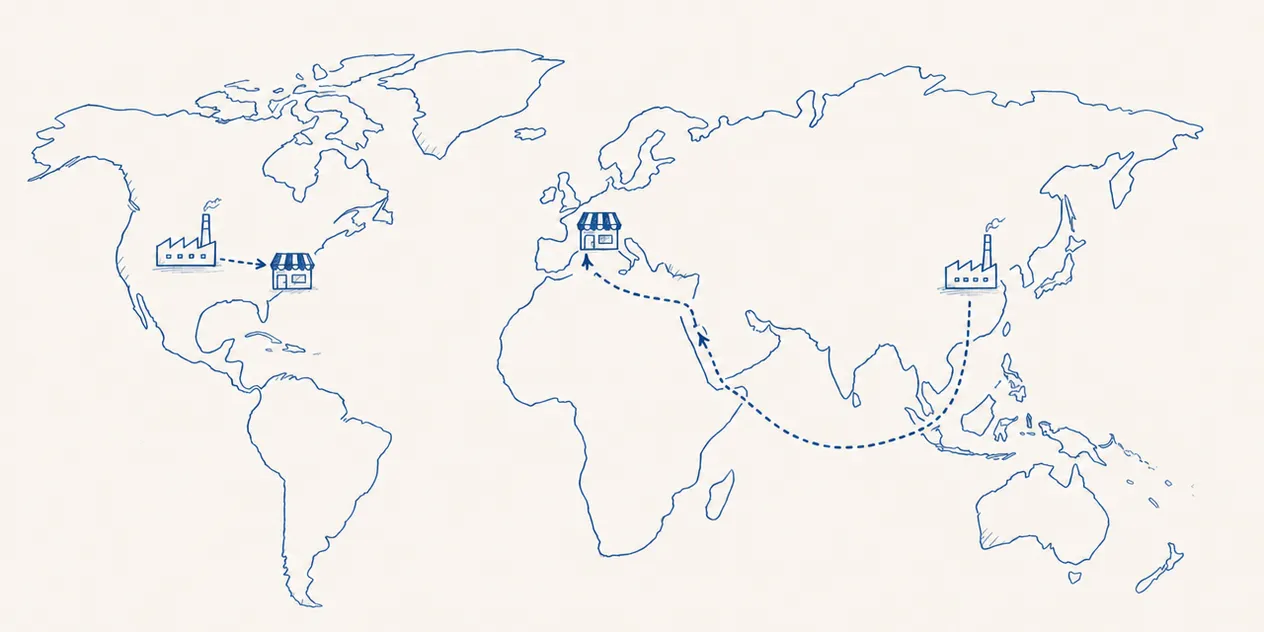
Lead time determines when the decision is made
Between China and Europe, a container ship either goes through Suez or sails around Africa, which adds about two weeks at sea. In 2026, the return to Suez is partial: Maersk was routing a third of its usual traffic through it at the time it announced a full return within the year (Kuehne+Nagel). Production, pre-carriage and customs clearance must be added.
The destination of a container is therefore decided two to three months before the sale, on a forecast that will change in the meantime. Two levers help to preserve some margin:
- delaying allocation, by having the goods arrive at a break-bulk warehouse and deciding the destination country only on arrival;
- pooling safety stock. Consolidating the stock of several warehouses reduces the safety stock required: for independent demands, it varies with the square root of the number of stocking points, according to the law formalised by David Maister in 1976 (Emerald). Consolidated stock, however, is further from customers.
In practice, fast-moving items are stored close to their markets, and slow-moving items in a central stock.
Borders matter as much as distance
The right location also depends on the customs regime applicable to the goods.
- Within the Union. The customs warehousing regime allows goods from third countries to be stored without paying duties or VAT for as long as they remain there; if they are re-exported outside the Union, to the United Kingdom or Switzerland for example, they do not incur them (douane.gouv.fr).
- To the United Kingdom. The trade agreement between the Union and the United Kingdom exempts only products originating in one or other party from duties. A product made in China and shipped from French stock pays duties on entry into the United Kingdom; the Portuguese textile line may be exempt, subject to proof of origin (gov.uk).
- To the United States. The exemption for shipments under 800 dollars is suspended for all countries, and US customs has made this lasting through two rules published in June 2026 (Federal Register). Serving American customers parcel by parcel from Europe now incurs duties and a declaration for each shipment.
- To the Union. Since 1 July 2026, the Union has abolished the duty exemption for shipments under 150 euros and applies a flat duty of 3 euros per item category (KPMG).
These rules change often. The system keeps them up to date, with dates, and the customs declarant validates them.
Forecasts change, and stock has to follow
The sales and marketing teams revise their forecasts every month, often in spreadsheets that do not all follow the same format, with comments: a campaign, a distributor, a trade show. Each revision raises the same question: where should the next containers be sent, and should stock be moved from one warehouse to another?
The large platforms offer their own mechanisms. Amazon distributes stock between the European countries activated by the seller according to expected demand (Amazon). ZEOS, Zalando’s logistics service, serves several sales channels, including brands’ own websites, from a single stock (Zalando). These options enter the calculation as possible locations among others.
What the system does
The system brings together the stock of each warehouse and goods in transit, forecasts by country, channel and item, the lead times and costs of each route, the origin of each product and the applicable duties. Every month, or at each major revision, it:
- proposes a destination for manufacturing orders and containers not yet allocated;
- proposes transfers between warehouses, setting their cost (transport, duties) against the stock-outs they avoid;
- flags items at risk of stock-out in a market, taking the replenishment lead time into account;
- explains each proposal: the forecast that changed, the lead time, the cost, the customs regime.
The language model reads the forecasts and their comments, writes the explanations and answers questions. Quantities, safety stocks and costs are calculated by a conventional calculation program, whose results are reproducible.
Oversight
A second system, separate from the one that makes proposals, checks each proposal before it reaches the planner:
- the forecast version used and the lead-time and cost assumptions are cited;
- the stock figures used match those in the warehouse software;
- duty rates refer to the official tariff (TARIC for the Union, the Harmonized Tariff Schedule for the United States), with their date;
- a proposal that takes goods out of a customs warehouse or ships them to the United Kingdom is submitted to the declarant.
No transfer is launched without the planner’s approval.
What remains with the teams
The target service level in each market, the acceptable amount of tied-up stock, the opening of a new warehouse: these are management decisions. The sales and marketing teams remain responsible for their forecasts, and the gap between forecast and actual sales is fed back to them every month, market by market, so that they can adjust.
Where to start
You need:
- stock by warehouse and goods in transit;
- twelve to twenty-four months of sales by country and channel;
- current forecasts, in their existing formats;
- the lead times and costs of the routes used, and the customs origin of each item.
You start with one flow, for example the first fifty items made in China and sold in Europe, the United Kingdom and the United States. The result is measured by stock-outs per market, tied-up stock and the number of transfers between warehouses.
Other uses of AI in transport and logistics, and a detailed scenario, are described on the page AI applied to logistics and transport.