AI in industry: where SMEs stand
In 2025, 17% of manufacturing companies with 10 or more employees use at least one AI technology, a rate close to the average across all sectors (18%). Across all sectors, 54% of companies that do not use it cite a lack of expertise (Insee, ICT survey 2025).
In a workshop of 10 to 500 people, value is lost in four places:
- Unwritten know-how. How a problem was solved fifteen years ago is known only to those who were there at the time.
- Quoting. It determines the margin and rests on two or three people. Some enquiries are never quoted.
- Proof. Customers and certifiers ask for files that are put together by hand as the audit approaches.
- The offer. The workshop can make more than it sells, but designing a finished product requires a design office it does not have.
Demonstration scenario
Selling complete kits when you used to deliver components
The company described is fictional. This scenario shows how we approach a problem; it does not report a result achieved for a client.
The situation
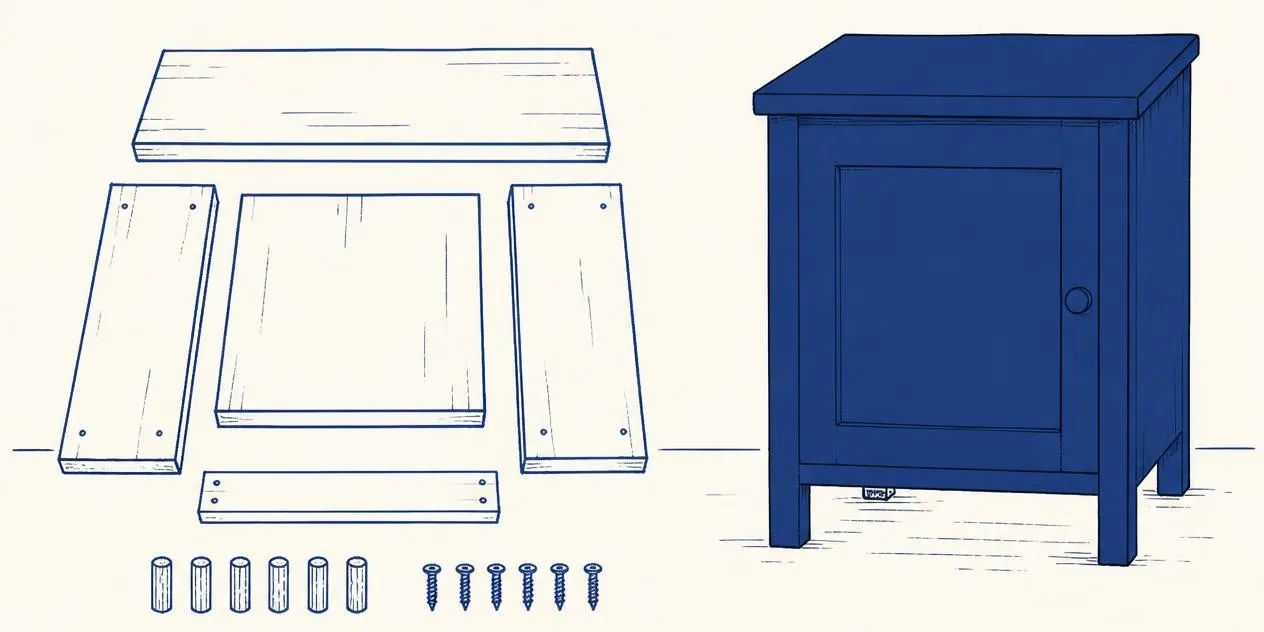
A cabinetmaking workshop with twenty-eight employees. It delivers solid wood components to hardware stores and merchants: fronts, drawers, tops, cut to the requested dimensions. The customer assembles them, and the value of the finished product goes to the customer.
Hardware stores are asking for ready-to-sell flat-pack furniture. The workshop could make it, but designing a complete kit requires a bill of materials, fittings, an assembly drawing, instructions and dimensional variants. Without a design office, the request goes unanswered.
What the company already has
Fifteen years of drawings and routings. The list of machines, tooling and wood species it works with. The tolerances the workshop foreman knows: a minimum thickness for each species, a maximum length for each machine.
What the system produces
The workshop foreman describes the piece of furniture wanted and its dimensions. The system starts from the parts the workshop already makes and returns a complete kit: the bill of materials, the fittings, the assembly drawing, the instructions, and the dimensional variants requested by the hardware store. Each part in the kit refers back to the routing used to make it.
What is verified
A second system, separate from the one that designed the kit, checks it before it goes into the catalogue:
- each part can be made with the workshop’s machines and tooling, within the tolerances of the chosen species;
- the bill of materials is complete: every screw and every dowel in the instructions is listed, in the right quantity;
- each step in the instructions uses only parts that are in the kit.
A kit that fails a criterion is returned with the criterion concerned. The record stays attached to the kit. The principle is explained in more detail on the home page.
What the system does not do
It does not decide which furniture to launch and does not set the selling price. Each kit is assembled once in the workshop before it goes on sale.
How the result is measured
The revenue generated by the kit range, from customers who until now bought only components.
Archives, compliance and in-house tools: three other uses of AI in industry
| Technical archives | Compliance files | In-house tools | |
|---|---|---|---|
| Today | Sketches, routings and test reports sit on paper, in three generations of CAD and on the network. Finding a past solution means asking someone who was there. | The CE, REACH or customer file is put together piece by piece before the audit, by the most qualified person in the company. | Quoting, scheduling or quality tracking live in a macro-laden spreadsheet or an application written fifteen years ago. Only one person knows how to modify it. |
| The system produces | The digitised archive, searchable in plain language. Each answer returns the original documents, their date and their author. | A file kept up to date continuously: each requirement linked to its supporting document and its expiry date. | Documentation of what exists: calculation rules, data flows, special cases. Then the tool is rebuilt on that basis. |
| What is verified | Every answer cites its documents. An answer without supporting documents is not returned. | The dated list of requirements covered, the documents that cover them and the gaps, with the documents about to expire. | The old and the new tool are run on the same data. Each difference in results is explained before the switchover. |
| Data needed | The archives as they are, paper included. | The applicable standards, existing documents, supplier declarations. | The existing tool, its files, and a few hours with the person who maintains it. |
What Marsanne does not do in industry
- Machine control. The system does not control any production equipment.
- Generic administrative tasks. Expense reports, meeting minutes: off-the-shelf tools are enough.
- Software that already exists. When an ERP, a CMMS or an MES covers the need, we say so and tell you which one.
To gauge the expected return on a project before launching it, see How to measure the return on investment of AI.
Frequently asked questions
Do we need to connect our ERP or CMMS?
Not to get started. The system works on exports and on the workshop's documents: drawings, routings, technical files. A few people use it in real conditions, and the question of connecting it comes up once the value has been demonstrated.
Some of our archives are on paper. Is that a problem?
No. Digitisation is part of the work. Drawings produced in several generations of CAD software are taken on as they are.
How long before we see a first result?
Development generally takes a few weeks. Users benefit as soon as they start using it.
What happens to our data?
Once the solution is in service, Marsanne no longer has access to your data. You remain its sole owner.
Will our teams need training?
No. The system is designed around the actual work of the team that uses it, and can be used without training.
Articles — Industry
- Small batches: quoting the one-off parts workshops used to turn down 3 October 2026
- Technical archives and AI: querying a workshop's know-how 28 September 2026
In the press
The latest articles from the studio's AI watch on AI in this industry, summarised in English with their source.
- ABB Robotics and SoftBank to open a major robotics centre in Sabadell
ABB Robotics and SoftBank will open a 15,000 m² robotics centre in Sabadell in 2028, linked to physical AI.
Expansión · 9 Oct 2026 · Spain - 58.5% of industrial companies already invest more than $10 million a year in AI
58.5% of industrial companies invest $10 million or more a year in AI, according to an IFS/Futurum Group study.
IT User · 9 Oct 2026 - Turning to AI, more sustainable models… BMW orchestrates its new strategy to stay in the race
BMW is restructuring its technology and turning to AI in the face of Chinese competition, while cutting costs.
Le Figaro · 8 Oct 2026 · Germany - Five Normandy companies test an AI that maps their experts' knowledge before they leave
Five Normandy companies are testing TellurIA, an AI that maps their experts' knowledge before they leave.
IT Social · 8 Oct 2026 · France - Building a safer path to autonomous industrial AI
Industrial AI is moving towards automating complex tasks thanks to foundation models, physical AI and agentic AI.
MIT Technology Review · 8 Oct 2026
Find out where AI can help in your workshop
The executive diagnostic takes ten minutes. It compares your answers with the situations we encounter in industry and gives you practical next steps.
Start the diagnostic