
A customer reports a crack in a welded part. The technical manager remembers that a similar problem arose some fifteen years ago, on a different reference. The solution exists somewhere: a test report, a change to a process sheet, a revised drawing. To find it, they have to ask the person who was there, if that person is still with the company.
In a workshop of 10 to 500 people, this know-how is spread across decades of projects, and it is rarely filed in a way that makes it easy to find.
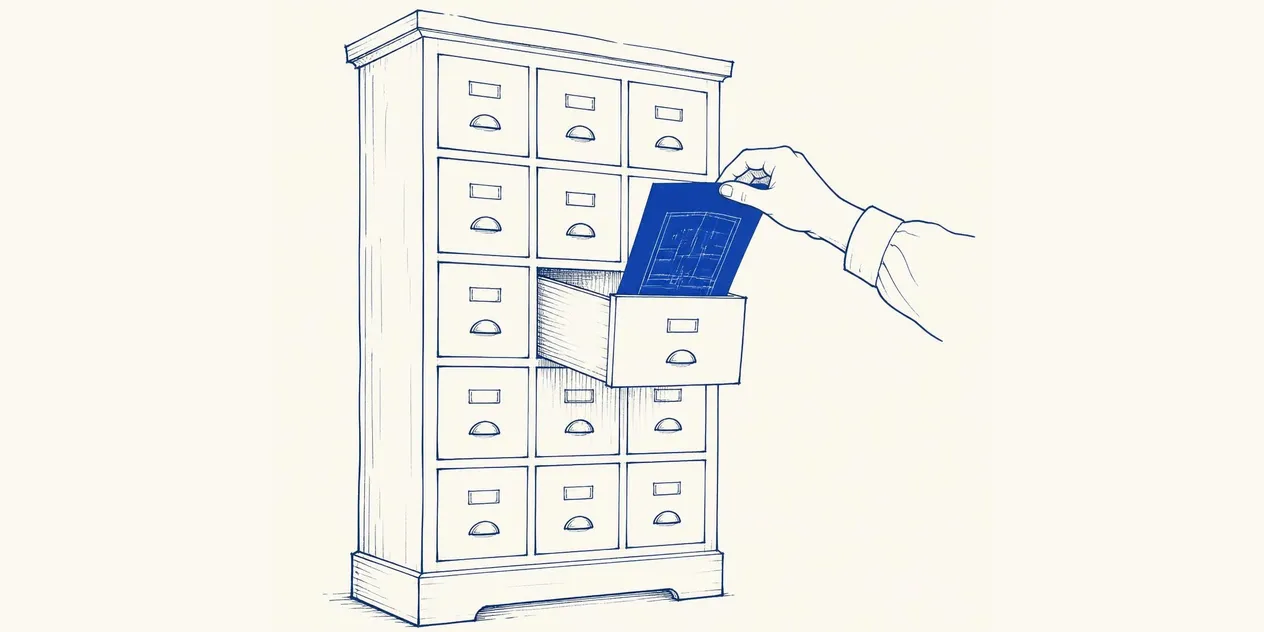
Why a workshop’s archives go unused
The archives exist, and they are extensive. They do not answer the questions put to them, for four reasons:
- Formats. Paper files, drawings produced by three generations of CAD software, spreadsheets and network folders named according to everyone’s own habits.
- Filing. Documents are filed by job number or by customer. The question concerns a technical problem: a crack, a dimensional drift, a surface defect.
- Vocabulary. The same defect goes by different names depending on the year, the team and the customer.
- Memory. Knowing which file to open requires knowing the history of the company. That knowledge leaves with retirements.
What the standard already requires
A workshop certified to ISO 9001 is familiar with this requirement. The 2015 version of the standard devotes a clause to organisational knowledge (§ 7.1.6): the company determines the knowledge needed for its processes, keeps it up to date and makes it available (ISO 9001:2015). A revision of the standard, published in September 2026, opens a transition period running until September 2029 (TÜV Rheinland).
In most SMEs, this requirement is covered by written procedures, while the knowledge drawn from past projects remains in the archives.
Making the archive searchable
The work starts with digitisation. Paper files are scanned, and older drawings are taken as they are, without prior conversion. The system then reads everything: text, tables, drawing title blocks, and handwritten annotations where legible.
The technician asks a question in plain language: “toe crack on a fillet weld in S355 steel, what did we do?”. The system returns the relevant documents, each with its date, author, the job concerned and what was decided at the time. It links the different vocabularies: a “crique” from 2008 and a “fissure” from 2019 refer to the same defect.
The rule: no answer without a source document
An answer based on archives is only worth something if you can go back to the archive. A second system, separate from the one that did the search, checks every answer before it is returned:
- each statement points to a specific document, down to the page or the title block;
- an answer in which a statement has no source document is not returned;
- two contradictory documents are presented together, with their dates, so that the technician can see which solution replaced the other;
- when the archive contains nothing on the question, the system says so and states which parts of the archive were searched.
The technician can thus open the 2009 report and check what the system drew from it.
What remains the team’s responsibility
The system finds. The decision to apply an old solution to a new case rests with the technical manager, who knows what has changed since: material, machine, customer requirement.
Questions left unanswered are also useful. They show what the company knows without ever having written it down. Time spent with experienced people on these specific questions fills gaps in the archive before they leave.
Where to start
Part of the archive is enough to get started: test and non-conformance reports, or the files for one product family. You need:
- the archives for that scope, as they are, paper included;
- around twenty real questions asked over the past year, with the answer the team eventually found;
- a technician who knows this archive, to assess the answers.
The system works on a copy of the archives, without connecting to the ERP or the document management system. The result is measured by the time needed to find a past solution, and by the share of questions that get an answer backed by a source document.
Other uses of AI in industry, and a detailed scenario, are described on the AI applied to industry page.