AI watch by industry
AI in the public sector
Public bodies in France, Germany and Spain are moving past pilots towards assistants used by tens of thousands of staff, mainly for document synthesis, case handling and citizen-facing queries. Measured gains exist but remain partial: usefulness ratings and time savings are documented for some tools, while other large claims are published without methodology. Adoption also varies sharply by size of organisation and stage of maturity, and sector-specific rules on staff consultation and data protection shape how quickly projects can scale.
Document assistants are the most common deployment
The recurring use case across administrations is an internal assistant for searching and summarising documents. Germany’s LLMoin, run by Dataport across seven Länder, reached 100,000 users by October 2026. France’s L’Assistant, built by the DINUM with Mistral AI on Outscale’s sovereign cloud, was rolled out generally in June 2026 after ten months of testing with 10,000 agents: 75 % found it useful and time savings of up to 16 % were measured on document synthesis. The French customs administration deployed a similar tool, Diane, combining retrieval, business rules and a language model on a sovereign cloud to help agents navigate customs law.


Adoption levels differ sharply depending on what is counted
Figures on adoption cover different populations and should not be compared directly. In France, a survey tied to the state’s Notre IA plan found 89 % of public agents already use AI; among them, 55 % rely on consumer tools that their administration has not validated. The plan aims to equip 1 million agents with a budget of €655 million. The French Hospital Federation reports 65 % of public hospitals have already deployed AI use cases, with 90 % planning to within three years. In the Basque Country, 21 % of organisations with ten or more employees use AI systems, up from 17.4 % the previous year. Spain’s public sector plans to devote 7.40 % of its IT budget to AI in 2027, according to Capgemini.
-
 Journal du Net · 5 October 2026 AI: the State is rolling out its use widely, but still has to govern decision-making Read the article on the publisher’s website ↗
-
 IT for Business · 12 October 2026 AI, a promising new treatment to relieve hospitals Read the article on the publisher’s website ↗
-
 SPRI · 14 October 2026 Artificial intelligence is consolidating in Euskadi and entering a new phase focused on its industrial impact Read the article on the publisher’s website ↗
-
 Computing · 8 October 2026 Spain accelerates public investment in artificial intelligence but hits the scaling wall Read the article on the publisher’s website ↗
Our summaries: Journal du Net, IT for Business, SPRI, Computing
Where results are measured, and where they are not
France Travail, the French employment agency, has equipped 50,000 agents with AI tools supporting the payment of €35-40 billion in benefits annually, and says its AI team has grown tenfold over eight years as it moved from pilots to industrialised use. In the United Kingdom, the Ministry of Justice reports that its Justice Transcribe tool processed more than 1.6 million probation meetings, with an illustrative estimate of 266,667 hours saved. However, no error rate for these transcriptions has been published, and a ministerial claim of a 50 % reduction in administrative note-taking time was made without a documented method, a reminder that announced gains are not always independently verifiable.
-
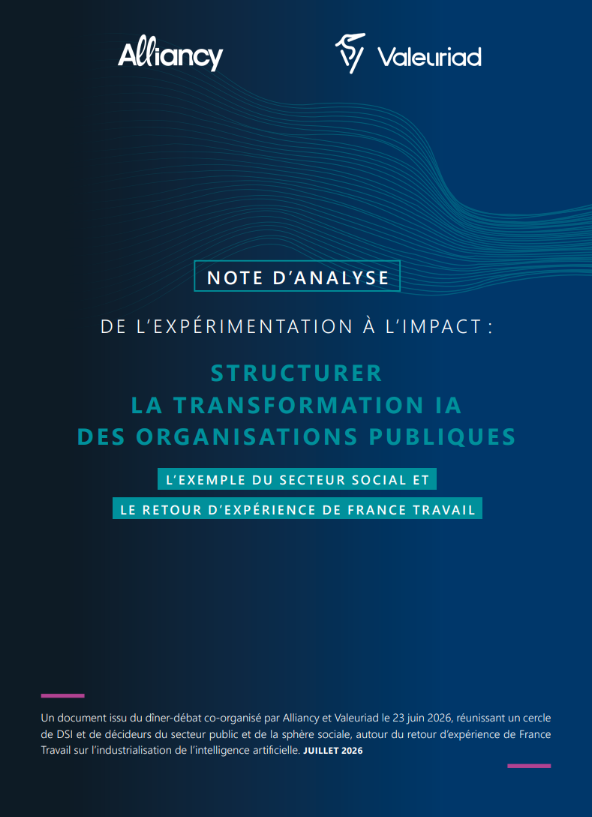 Alliancy · 28 September 2026 From experimentation to impact — Structuring AI transformation in public organisations Read the article on the publisher’s website ↗
-
 ActuIA · 2 October 2026 UK justice system publishes the number of its AI summaries, not their error rate Read the article on the publisher’s website ↗
Data readiness and the move from prototype to production are the real obstacles
Officials who have gone through deployment describe the preparatory work as the main constraint. France’s Directorate General for Local Authorities had to map and structure its information assets before using AI: the ACTES system alone processes seven million administrative acts a year, with peaks of 30,000 a day, and required building a dedicated semantic model before AI tools could add value. The European Space Agency, which has deployed around fifty AI use cases, mostly document-search assistants, reports that moving from prototype to production represents about 80 % of the total effort, even when the initial model works well.
-
 IT for Business · 11 September 2026 Laurence Houdeville (DGCL): "AI is not magic" Read the article on the publisher’s website ↗
-
 L'Usine Nouvelle · 6 October 2026 · paywalled “Sovereignty means keeping the essentials in our own hands”: ESA simplifies the deployment of AI tools while retaining control over their development Read the article on the publisher’s website ↗
Our summaries: IT for Business, L'Usine Nouvelle
Staff consultation and data protection rules shape deployment timing
The EU AI Act entered its application phase in August 2026, with high-risk obligations covering HR, credit, education and biometrics delayed to December 2027, and fines of up to €35 million or 7 % of global turnover for prohibited practices. The CNIL notes that GDPR already applies to AI systems processing personal data, ahead of the high-risk rules, which generates compliance requests from organisations. In France, courts have repeatedly required employers to consult staff representative bodies before deploying AI: a reorganisation at GISI (Infopro Digital) that shifted 70 % of eight editorial roles to AI was suspended, and RATP’s main union has filed a formal alert over AI projects introduced without prior consultation.
-
 ActuIA · 6 October 2026 AI Act: obligations in force and postponements under omnibus 2026/1744 Read the article on the publisher’s website ↗
-
 Alliancy · 3 September 2026 State services: "Some fairly basic security measures are not being implemented" Read the article on the publisher’s website ↗
-
 ActuIA · 7 October 2026 When to consult the CSE before deploying AI (October 2026) Read the article on the publisher’s website ↗
-
 ActuIA · 5 October 2026 AI at RATP: the social alert centres on consulting the CSE Read the article on the publisher’s website ↗
Smaller organisations lag on compliance and return on investment
Scale-related gaps are visible within the same dataset. In the Basque Country, 35.5 % of large companies are already working to align with the AI Act, against 13 % of SMEs. Overall, 87 % of organisations studied invest in AI, but only one in four recovers that investment within a year. In France, the Osez l’IA plan reports that SME and mid-sized-company leaders’ interest in AI rose from 48 % to 86 % and launched projects from 15 % to 55 %, according to Siparex and Bpifrance. Yet of 35,000 companies reached through 615 ambassadors, only 70 have engaged a funded data-and-AI diagnostic, a gap between the sensitisation effort and the number of projects actually funded and deployed.
- SPRI · 14 October 2026 Artificial intelligence is consolidating in Euskadi and entering a new phase focused on its industrial impact Read the article on the publisher’s website ↗
-
 Techniques de l'Ingénieur · 5 October 2026 "Osez l'IA" plan: what has been achieved in its first year? Read the article on the publisher’s website ↗
Our summaries: SPRI, Techniques de l'Ingénieur
Articles cited
- LLMoin, the AI assistant that seven German Länder share ActuIA, 15 October 2026
- Artificial intelligence is consolidating in Euskadi and entering a new phase focused on its industrial impact SPRI, 14 October 2026
- AI, a promising new treatment to relieve hospitals IT for Business, 12 October 2026
- Spain accelerates public investment in artificial intelligence but hits the scaling wall Computing, 8 October 2026
- When to consult the CSE before deploying AI (October 2026) ActuIA, 7 October 2026
- AI Act: obligations in force and postponements under omnibus 2026/1744 ActuIA, 6 October 2026
- “Sovereignty means keeping the essentials in our own hands”: ESA simplifies the deployment of AI tools while retaining control over their development L'Usine Nouvelle, 6 October 2026
- "Osez l'IA" plan: what has been achieved in its first year? Techniques de l'Ingénieur, 5 October 2026
- AI at RATP: the social alert centres on consulting the CSE ActuIA, 5 October 2026
- AI: the State is rolling out its use widely, but still has to govern decision-making Journal du Net, 5 October 2026
- UK justice system publishes the number of its AI summaries, not their error rate ActuIA, 2 October 2026
- From experimentation to impact — Structuring AI transformation in public organisations Alliancy, 28 September 2026
- French Customs industrialises its generative AI on a sovereign cloud Alliancy, 24 September 2026
- Laurence Houdeville (DGCL): "AI is not magic" IT for Business, 11 September 2026
- State services: "Some fairly basic security measures are not being implemented" Alliancy, 3 September 2026
Another question?
Claude searches the articles in the watch and answers you, citing its sources.
Answer written by an AI model (Claude, by Anthropic) from the articles in the watch only: check the figures in the sources. Questions are recorded;learn more.
Method
Text written on 20 October 2026 by an AI model (Claude Sonnet 5, by Anthropic) from 74 AI watch articles on this theme, published between 14 May 2025 and 18 October 2026. Each paragraph links to the entries it draws on, and every number in the text was found in one of these articles before publication. The text is rewritten every week.
Other industries
- AI in manufacturing
- AI at family offices and private wealth advisory firms
- AI in retail and distribution
- AI in transport and logistics
- AI in healthcare
- AI in consulting, law and accounting
- AI in software, IT services and telecoms
- AI in energy and utilities
- AI in construction and real estate
- AI in tourism and hospitality
- AI in media, communication and marketing